For Pilots
Planning a visit to Atlantic? Get to know the airfield, explore the proposed joining arrangements and speak to our FBO team to plan your arrival.
021 007 0808 · 24 hoursRead the proposed joining briefingOperating information — approval pending
SOP Revision 1 is prepared for initial SACAA submission and is not yet approved or effective. Proposed joining, circuit and night procedures are not released for operational use. The proposed daytime briefing and drawings below are public for assessment; these proposed flight procedures are not effective operating instructions. Approved procedures and diagrams will be published with their revision and effective date once approval and release conditions are satisfied.
Contact the duty FBO Manager for current confirmed information. This website is not an operational clearance or a substitute for current authorised aeronautical information and notices.
Atlantic Aerodrome joining procedures
PROPOSED DAYTIME ARRANGEMENT — AWAITING ASSESSMENT AND APPROVAL
These procedures and drawings describe the proposed daytime joining arrangement. They are not yet effective operating instructions. Drawings are schematic and not for navigation. Before flight, obtain the current issued procedures, applicable AIP/NOTAM information and aerodrome serviceability information.
| Item | Proposed arrangement |
|---|---|
| Local overhead join | 2,500 ft AMSL on QNH |
| Fixed-wing circuit | 1,200 ft AMSL on QNH |
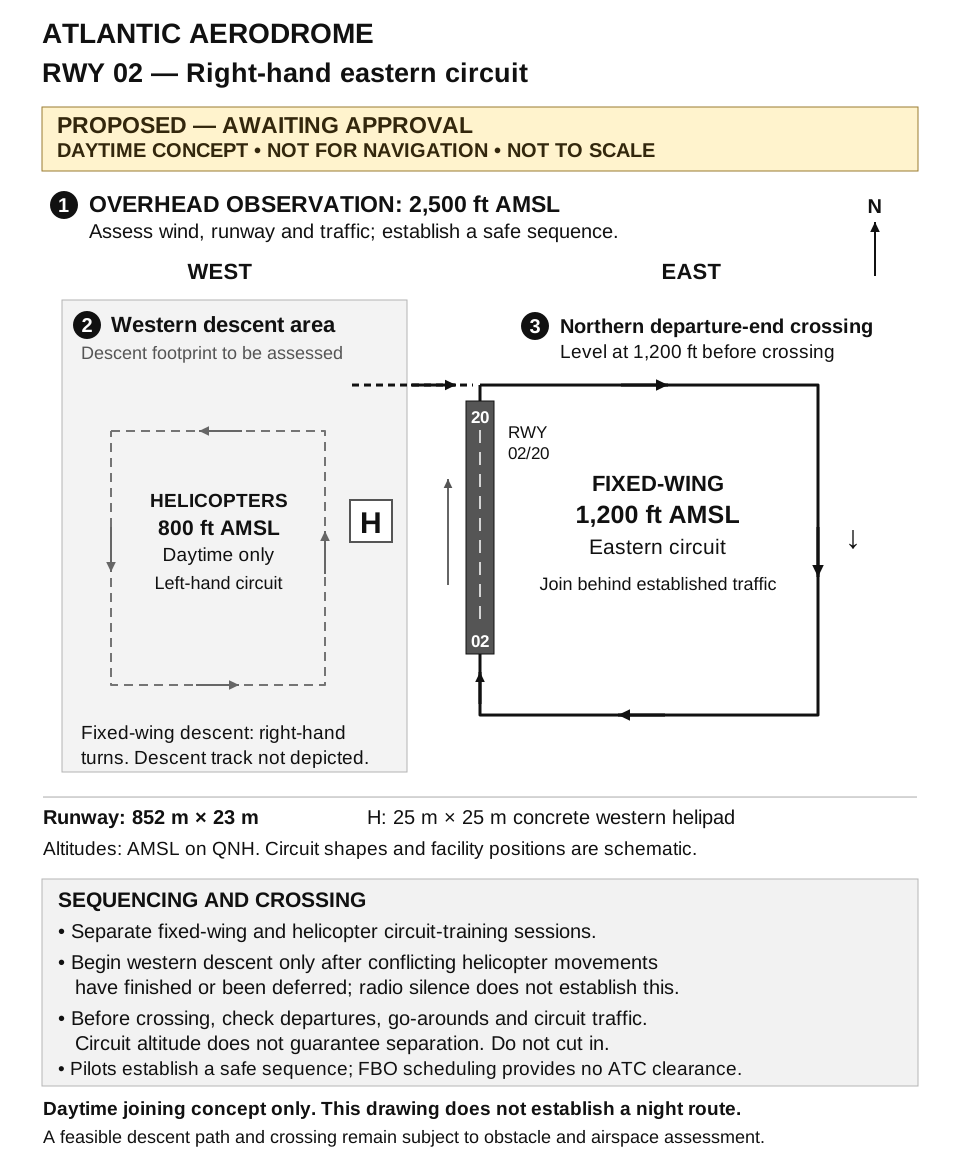
| RWY 02 | Right-hand circuit, east of the runway |
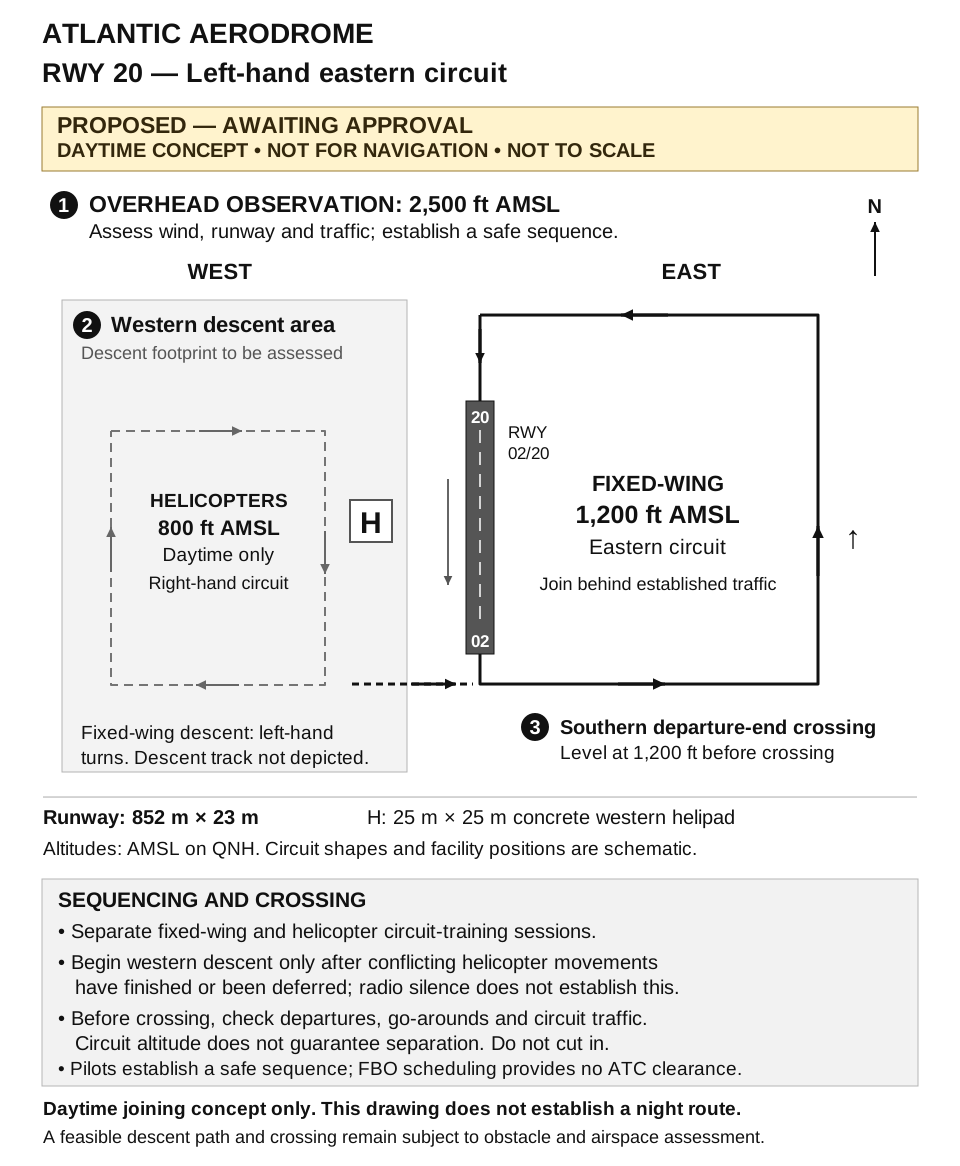
| RWY 20 | Left-hand circuit, east of the runway |
| Daytime helicopter circuit | West of the runway, 800 ft AMSL on QNH |
Daytime joining sequence
- Observe overhead. At the proposed local overhead altitude of 2,500 ft AMSL, assess wind, runway use and traffic. Establish a safe sequence. This altitude does not apply automatically throughout the inbound route; comply with the airspace occupied.
- Check before descending. Account for departures, go-arounds and other joining aircraft. Helicopters also operate west of the runway: conflicting helicopter movements must have finished or been deferred. Radio silence does not establish that the area is clear.
- Descend west of the runway. Use the circuit turn direction and allow sufficient room for a normal descent. Be level at 1,200 ft AMSL before crossing the departure end towards the eastern circuit.
- Check again before crossing. Avoid conflicting departures, go-arounds and circuit traffic. For RWY 02, cross the northern departure end, then turn right into the eastern circuit. For RWY 20, cross the southern departure end, then turn left.
- Join behind established traffic without cutting in. Maintain lookout and broadcast positions and intentions. If a safe sequence cannot be established, do not begin the conflicting descent or crossing. No holding orbit is prescribed by these drawings.
A direct circuit join or straight-in approach is conditional on the issued procedure, applicable rules and absence of conflict or disruption. Radio calls and FBO bookings provide neither priority nor an air traffic clearance.
Fixed-wing and helicopter circuit-training sessions are scheduled separately. Different circuit altitudes do not guarantee separation.
These drawings do not establish night routes. Night operations require the applicable approved procedures and confirmed serviceable lighting. Repetitive night helicopter circuit training is excluded.
Aerodrome information: RWY 02/20, asphalt, 852 m between thresholds × 23 m wide; elevation 247 ft AMSL. Use the applicable declared distances and aircraft performance requirements when planning operations.
Proposed daytime joining drawings
View or download either drawing without signing in. Both are proposed concepts awaiting approval, not navigation charts. The members portal remains for registration and bookings when operational.
RWY 02 · Right-hand eastern circuit
Read the drawing description
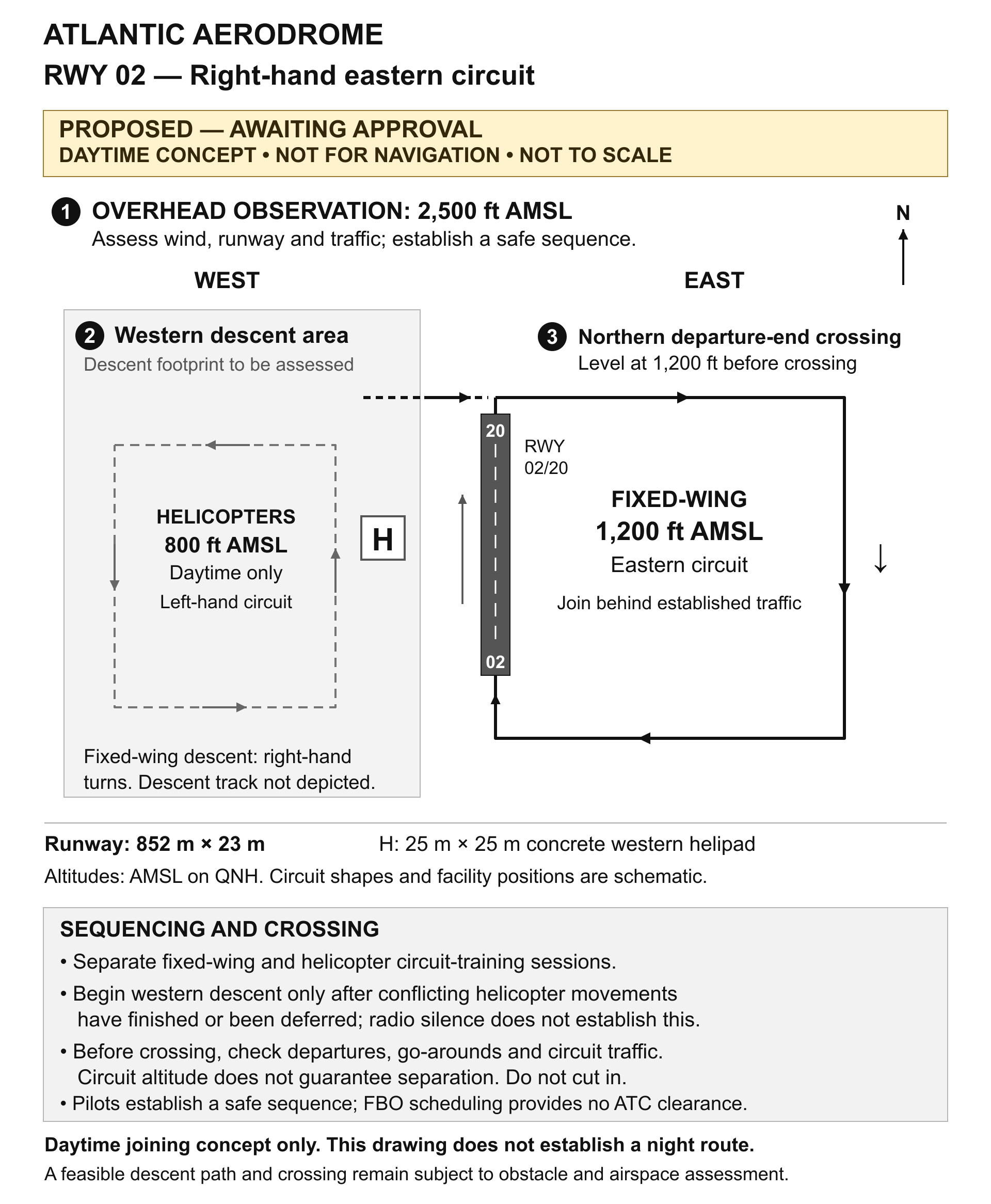
Not for navigation. Schematic, not to scale. The proposed overhead altitude is 2,500 feet AMSL on QNH. Fixed-wing aircraft descend west using right-hand turns, after conflicting helicopter movements have finished or been deferred. They must be level at 1,200 feet AMSL before crossing from the western side at the northern departure end into the eastern right-hand circuit. Check departures, go-arounds and established circuit traffic before crossing. The western daytime helicopter circuit is left-hand at 800 feet AMSL. Fixed-wing and helicopter circuit training are scheduled separately. No fixed-wing descent track is drawn. The flight paths require obstacle and airspace assessment and approval. The diagram does not establish a night route.
RWY 20 · Left-hand eastern circuit
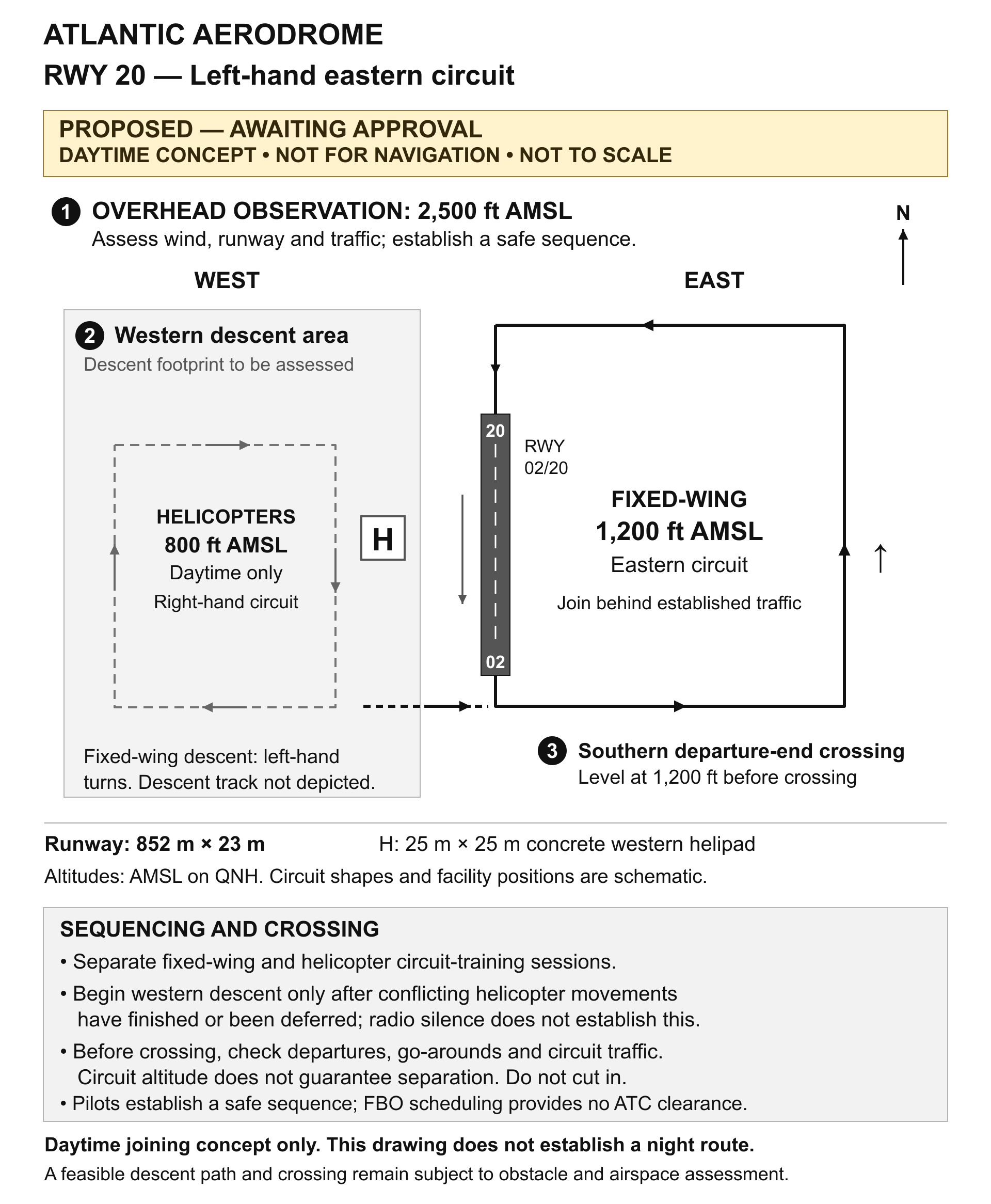
Read the drawing description
Not for navigation. Schematic, not to scale. The proposed overhead altitude is 2,500 feet AMSL on QNH. Fixed-wing aircraft descend west using left-hand turns, after conflicting helicopter movements have finished or been deferred. They must be level at 1,200 feet AMSL before crossing from the western side at the southern departure end into the eastern left-hand circuit. Check departures, go-arounds and established circuit traffic before crossing. The western daytime helicopter circuit is right-hand at 800 feet AMSL. Fixed-wing and helicopter circuit training are scheduled separately. No fixed-wing descent track is drawn. The flight paths require obstacle and airspace assessment and approval. The diagram does not establish a night route.
24-hour FBO contact
021 007 0808 / +27 21 007 0808Runway & Helipad
- Runway
- 02/20
- Threshold-to-threshold
- 852 m × 23 m wide
- Surface
- Asphalt
- Elevation
- 247 ft AMSL
- Traffic frequency
- 124.4 MHz — verify current information
- Intended MTOW ceiling
- <23,000 kg
- Intended wingspan limit
- <24 m
- Western helipad
- 25 m × 25 m, concrete, lighted
The runway and taxiways are asphalt; the helipad is concrete. Hangar aprons are paved, and internal hangar floors are concrete.
Before You Fly
The paved runway is 852 m threshold-to-threshold. Planned neighbouring land leases do not add paved runway length.
Physical length is not an approved declared distance. Proposed TORA, TODA, ASDA and LDA remain subject to technical reconciliation and approval. Obtain the approved direction-specific distances before performance planning.
The intended aircraft limits are MTOW <23,000 kg and wingspan <24 m. These are ceilings, not a verified pavement rating or a guarantee of suitability for any aircraft below them.
Each operation also depends on aircraft performance, runway distances, substantiated pavement limits, obstacles, weather, operating conditions and applicable approvals. The pilot-in-command and operator remain responsible for establishing suitability.
No ATC or AFIS service is declared. FBO and Security support does not provide air traffic control or separation; radio acknowledgements are not air traffic clearances.
Planning Your Visit
These are the arrangements set out in SOP Revision 1. They apply to the relevant operations only when the SOP is approved, effective and its release conditions are met.
Permission & Hours
Ordinary operations use standing permission under the SOP; routine individual landing PPR is not required. Indemnity acceptance remains required and is separate from landing permission.
Normal hours: 07:00–17:00 SAST daily.
For after-hours operations, give 24 hours’ notice where possible and obtain confirmation before flight. Applicable fees apply; shorter notice may be accommodated.
Arrangements & Bookings
Contact the duty FBO Manager at least 60 minutes before your visit for service arrangements. We’ll do our best to accommodate shorter notice. Our team can also help with current rates, applicable rules and indemnity documents.
The members portal will support bookings and registration for resident and visiting pilots when operational. Please arrange services directly with the FBO until the portal is operational.
021 007 0808 · 24 hoursInternational: +27 21 007 0808
Contact the FBOLighting & Night Operations
Planned arrangements — not an operational release. Night use remains subject to approval, serviceability and verified lighting and hold arrangements.
Shared 30-minute lighting bookings switch both runway and helipad lights on at the booked start and off at expiry unless an acknowledged extension or manual hold applies.
Arrange another slot through the FBO (or the portal when operational), or call 021 007 0808. There is no aircraft-radio-click activation. A radio request requires Security’s acknowledgement.
A confirmed hold covers all acknowledged movements requiring the lights. Pilots must not assume continued lighting without confirmation. A booking does not establish serviceability or guarantee uninterrupted lighting.
The intended night scope includes fixed-wing circuits and touch-and-go training, and helicopter arrivals and departures, subject to approval and serviceability. Repetitive night helicopter circuit training is excluded. Fixed-wing and helicopter circuit-training sessions are scheduled separately.
Services & Support
Fuel types: Mogas, Avgas and Jet A1, subject to verified specification, stock and serviceability. Confirm the required specification and availability with the FBO before flight.
Maintenance businesses are included in the intended scope. Confirm the required service and provider before making arrangements.
Visiting medical flights may be accommodated by arrangement. No resident EMS operator is confirmed, and no dedicated on-site aerodrome rescue/firefighting service is declared. Emergency response is not guaranteed.
The previous brochure has been withdrawn because it contained obsolete runway information. Current facts are on this page; approved operational downloads will be made available once effective.
Explore FBO Services